RFID Labels: Industrial-Grade Tracking That Does More Than Stick

Radio frequency identification (RFID) has changed the way businesses track assets, manage inventory, move products through supply chains, and meet compliance requirements. RFID labels carry embedded inlays that communicate wirelessly with readers, giving your operation real-time data without line-of-sight scanning or manual input. For high-volume facilities running tight margins, that speed and accuracy add up fast.

We manufacture thermal transfer and direct thermal labels and tags that work alongside RFID technology. We understand what it takes to build an RDIF tracking label that holds up in the same environments your RFID system is used in.


Request a free sample from BarcodeLabels.com and test the material in your facility before you commit.

Core

Format

Label Size

Material

Applications

Printer Compatibility

Roll
Gloss Polyester Thermal Transfer with Aggressive Tire Adhesive (PGT)
As low as $334.53
Floodcoat, Informational Labels and Tags, Labels, Roll, Thermal Transfer
PolyMatte Thermal Transfer(PM)
As low as $109.00
Coming soon image
Floodcoat, Informational Labels and Tags, Labels, Roll, Thermal Transfer
PolyMatte Thermal Transfer(PM)
As low as $320.00
Roll
Gloss Polyester Thermal Transfer with Aggressive Tire Adhesive (PGT)
As low as $334.62
Roll
Thermal Transfer Matte Polyester
As low as $92.98
Roll
Thermal Transfer Matte Polyester
As low as $225.40
Roll
Gloss Polyester Thermal Transfer with Aggressive Tire Adhesive (PGT)
As low as $588.17
Informational Labels and Tags, Labels, Roll, Uncategorized
Gloss Polyester Thermal Transfer with Aggressive Tire Adhesive (PGT)
As low as $900.00
Roll
PolyMatte Thermal Transfer(PM)
As low as $143.00

What Goes Into an RFID Label

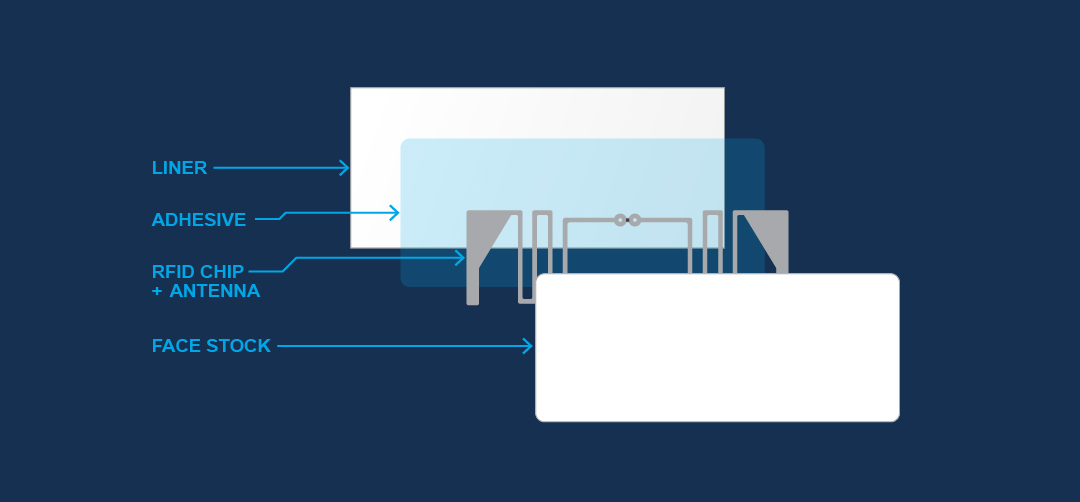
An RFID label combines face stock, an adhesive layer, and an embedded inlay with an antenna and microchip that stores and transmits data. When a reader sends out a radio signal, the inlay in the label picks it up, powers the chip, and transmits stored information back. No scanner. No human involvement required. No line of sight required.

UHF RFID labels operate in the 860-960 MHz range and are the go-to for supply chain, warehouse, and asset tracking applications. They read at distances up to 30 feet and handle bulk reads, scanning hundreds of items at once without individual tagging. That’s where the real operational payoff comes from.

RFID Labels vs. Barcode Labels: What the Job Requires

Barcode labels require a direct line of sight and a scan for every single item. RFID labels can read multiple tags simultaneously through packaging, pallets, and containers. Typical applications include labeling for receiving docks, inventory control, asset tracking across large facilities, and compliance shipments where speed and traceability are non-negotiable.

Barcode labels remain the stronger choice for short-run, cost-sensitive operations or environments where read distance and bulk scanning don’t matter. When you need both on the same label, a scannable barcode plus embedded RFID, thermal transfer RFID label stock handles it cleanly.

Facilities running RFID alongside thermal transfer, QR codes, and warehouse rack labels will find everything they need at BarcodeLabels.com.

Industries Using RFID Labels

RFID labels are already embedded in daily operations across the industries that BarcodeLabels.com has served for over 25 years:

Dock receiving, carton tracking, and pallet verification move faster with RFID. Inventory counts that used to take hours now take minutes.

RFID tags track parts through production, assembly, and shipping. Tier 1 and Tier 2 suppliers use both RFID and AIAG-compliant barcode labels to meet OEM requirements.

Equipment tracking, supply chain verification, and specimen identification all benefit from RFID’s read-without-contact capability.

Item-level tagging, replenishment triggers, and loss prevention rely on RFID labels that stay readable from the production floor to the store shelf.

BarcodeLabels.com has been manufacturing labels for these industries for over 25 years. Request a free sample today and see how our materials hold up in your environment.

Label Materials and Printer Compatibility for RFID Applications

The inlay is only part of the equation. The face stock, adhesive, and print method all affect how long an RFID label performs in the field, especially when the label is easily attached to rough, curved, wet, or metal surfaces.

Metal RFID Labels

Metal RFID labels require on-metal inlay designs and face stocks that can withstand metallic surfaces without signal interference. Standard inlays detune and lose read range on metal. On-metal RFID labels use a spacer layer to keep the antenna off the surface, maintaining performance.

Thermal Transfer Printing

For most label stocks, thermal transfer printing gives you the sharpest, most durable print on an RFID label face. The heated printhead transfers ink from the ribbon to the label without degrading the inlay. Direct thermal works well for short-term applications, though its heat sensitivity limits it in high-temperature environments.

Label Stock Built to Printer Specs

RFID printers from Zebra’s ZT and ZD series, as well as SATO and Datamax models, encode and print RFID labels in a single pass. BarcodeLabels.com manufactures label stock to OEM specifications for these RFID printer models, so roll dimensions, core size, and material thickness fit without adjustment.

Request Samples from BarcodeLabels.com for Your RFID Project

The inlay type, face stock, adhesive, and printer all need to be aligned before you commit to a full production run. Getting that wrong means reprints, failed reads, or labels that don’t survive the environment they’re meant to track in. Starting with tested materials cuts the risk before it becomes a problem.

BarcodeLabels.com offers free samples so you can test materials in your facility before placing an order. Request yours today and see firsthand how American-made label stock performs alongside your RFID hardware and encoding setup.

FAQs

Our RFID labels are available in UHF (902–928 MHz) for supply chain and industrial applications with multi-foot read ranges, and HF (13.56 MHz) for healthcare and access control, where closer reads and tighter data security are needed. Contact our team to match the right frequency to your reader setup.

Yes, our RFID label stock is designed for in-house printing on RFID-enabled thermal transfer printers from all major brands. That means you encode unique data at the point of print and reorder blank stock rather than pre-encoded labels.

The read distance of our RFID labels depends on the inlay type, the reader’s output power, and the environment. UHF labels typically scan reliably from 3 to 20 feet under standard conditions, and we carry on-metal inlays for applications where metal surfaces or liquids are a factor.

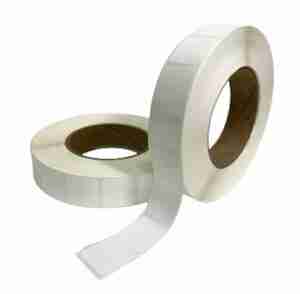
Standard RFID inlays lose performance when applied directly to metal because the surface interferes with the antenna. Our on-metal RFID labels use a spacer layer to ensure the antenna performs correctly. Contact our team if your application involves labeling metal equipment, racks, or tools.